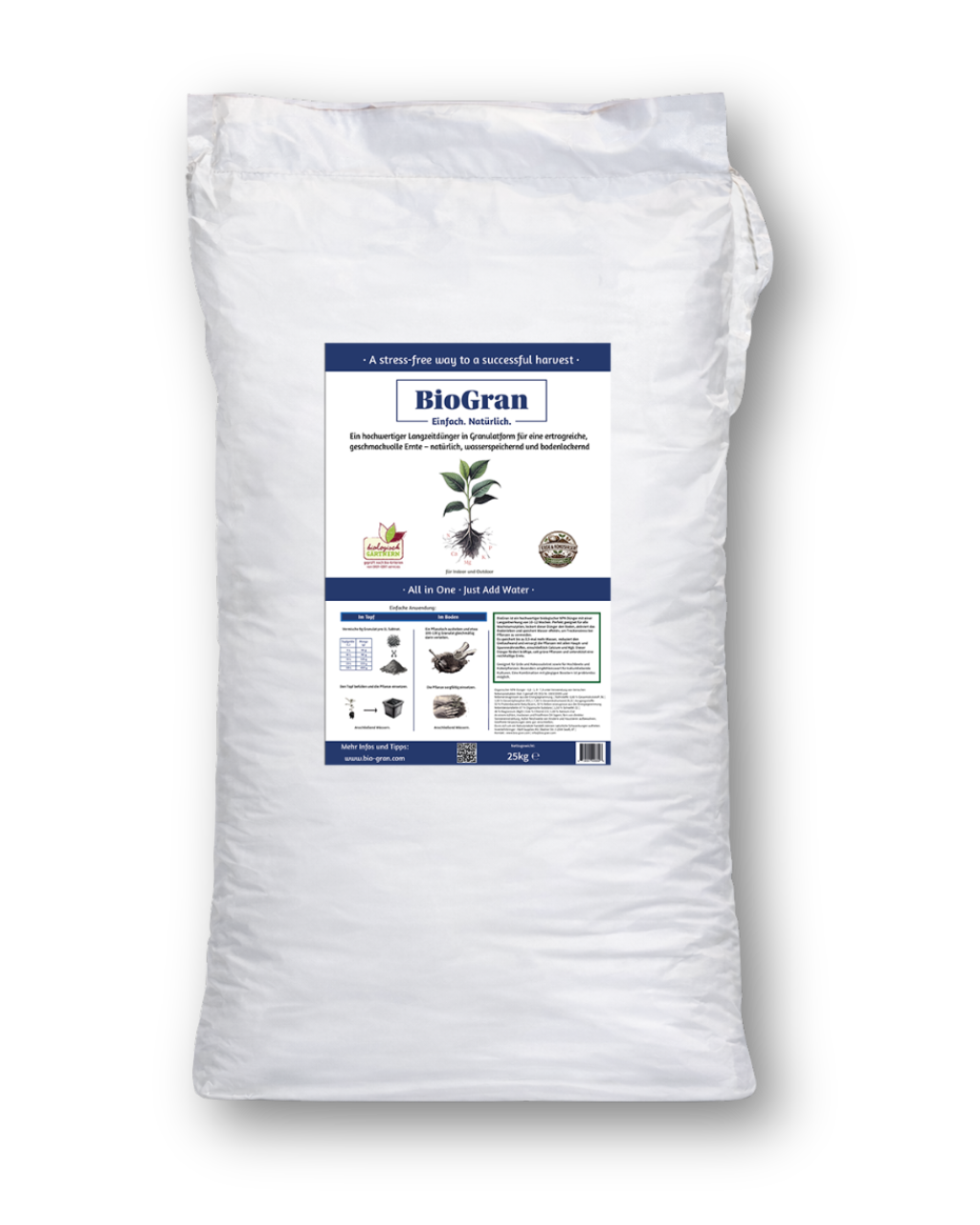
For a healthy start, even growth, and long-term organic nutrient supply, the right combination of substrate, moisture, climate, and application is crucial. With BioGran, you create the ideal foundation for strong indoor plants.
Choosing the Right Substrate
For Indoor Use: Soil from a Grow Shop
For indoor cultivation, high-quality soil from a grow shop is the ideal choice. It is usually stored securely and is mostly free from pests. This is particularly important because indoors, natural predators are absent, and pests can multiply much faster.
-
Lightmix soil for seedlings and very young plants
-
Slightly pre-fertilized soil for larger plants when repotting
- For large pots from approx. 25 liters, Lightmix can also be useful, as the larger volume provides enough buffer for the initial phase until BioGran is fully activated
Highly Recommended: Soil with Perlite
A mixture of soil and perlite significantly improves the substrate's structure. Perlite ensures better drainage, reduces the risk of waterlogging, increases oxygen supply in the root zone, and creates optimal conditions for healthy plant growth.
Using BioGran in Coco Substrate
BioGran can also be easily used in coco substrate. Coco impresses with its loose structure and very good aeration, but naturally contains few nutrients. This is precisely where BioGran excels: the granules compensate for this deficiency and supply the plant with essential nutrients over a longer period.
Important for Coco Substrate
- Coco stores hardly any nutrients
- In the initial phase, it can bind calcium and magnesium
- Nutrients are not buffered in coco and are not immediately available to the plant in a stable form
Therefore, it is particularly important to ensure consistent moisture in the first few days and to lightly support the plant if necessary until the system has stabilized.
Our recommendation: Coco substrate is more suitable for advanced hobby gardeners who already have experience with irrigation and nutrient management.
BioGran Application in 3 Simple Steps
1. Measure and Thoroughly Mix Granules
Mix 9 g of BioGran per liter of substrate evenly. Only when the granules are well distributed can the nutrients be released uniformly later and be continuously available to the plant.
Practical Tip
The easiest way to mix is in a mortar tub or a larger container. Example: For 40 liters of substrate, you need 360 g of BioGran. This is enough, for instance, for four 10-liter pots.
2. Plant Insertion
Fill the pot with the prepared substrate-BioGran mixture, leaving about 2–3 cm of space from the rim. Carefully insert the plant so that the roots are well embedded and not damaged.
Then, if necessary, fill with more substrate and lightly press down – not too firmly, so that the roots get enough air.
3. Watering and Care
After planting, water the plant evenly around the root ball so that the substrate is thoroughly moistened. Ensure consistent moisture, but avoid waterlogging.
Especially in the first few days, the substrate should not dry out completely, as this slows down the activity of microorganisms and delays nutrient release.
Optimal Start-up Phase
BioGran is an organic slow-release fertilizer and is activated by microorganisms in the substrate. Nutrients are released continuously, but are not immediately fully available.
To prevent growth delays in the initial phase, it is advisable to lightly support the plant for the first 7–10 days – especially with Lightmix, coco substrate, or sensitive young plants. After that, BioGran usually reliably takes over long-term nutrient supply.
Optional: Microorganisms
Adding microorganisms such as beneficial bacteria or fungi can accelerate the activation of BioGran and improve nutrient availability. Especially in Lightmix or coco substrate, this ensures a more stable and vigorous start.
Climate and Environment
In addition to substrate and fertilization, climate also plays a decisive role. Temperature and humidity influence both plant growth and the activity of microorganisms in the soil.
Day
22–26 °C
Night
18–21 °C
At excessively low temperatures, microbial activity slows down, which means nutrients are released more slowly. High temperatures can cause stress and disturb the balance in the substrate.
Also, ensure stable humidity and good air circulation to optimally support root development and nutrient uptake.
Is additional fertilization necessary?
In most cases, no. BioGran is designed to supply the plant with nutrients over a long period. Additional fertilization is usually not required. Crucial factors are correct dosage, thorough mixing, adapted watering, and a clean initial phase.
The Basic Principle of BioGran
BioGran is an organic long-term system. Nutrients are not released abruptly, but step by step – depending on moisture, temperature, and active soil life.
If these factors are correct, a stable system is created for healthy plants, even growth, and reliable supply over a long period.
Troubleshooting – Common Problems Easily Solved
Slow Growth or Pale Leaves
Especially in the initial phase, there might be a slight temporary nutrient deficiency because BioGran first needs to be activated.
Solution: Lightly support during the first few days and ensure consistent moisture in the substrate.
Problems in Coco Substrate
Coco stores hardly any nutrients and can bind certain elements in the initial phase.
Solution: Monitor the start-up phase particularly carefully, do not let it dry out, and gently supplement if necessary.
Too Dry Substrate
If the substrate dries out too much, the activity of microorganisms slows down. This leads to slower nutrient release.
Solution: Water regularly and consistently without causing waterlogging.
Dark Leaves or Deformations
This can indicate too high a nutrient concentration or additional fertilization.
Solution: Water with more water and temporarily reduce or omit additional fertilizer.
Weak Soil Life
Cold, drought, or unfavorable conditions can inhibit the activity of microorganisms.
Solution: Keep the substrate consistently moist, ensure appropriate temperatures, and optionally supplement with microorganisms.
Uneven Growth
Often, the granules are not evenly enough distributed in the substrate.
Solution: Always mix BioGran thoroughly and completely before potting.